









 0
0
 0
0
www.alliance2k.org – Across the latest robotics and automation news, one trend stands out on the factory floor: humans and collaborative robots forming tight-knit teams. These “cobots” no longer sit behind cages or distant safety lines. Instead, they move beside technicians, assemblers, and quality specialists, sharing space, tools, and even workflows with remarkable precision.
This new alliance reshapes how plants respond to volatile demand, labor shortages, and rising quality expectations. Cobots support workers with repetitive or ergonomically risky tasks while people handle judgment calls, creative problem solving, and nuanced decision-making. In today’s robotics and automation news cycle, this human-robot partnership is becoming the defining storyline of smart manufacturing’s next chapter.
The New Face of Factory Work
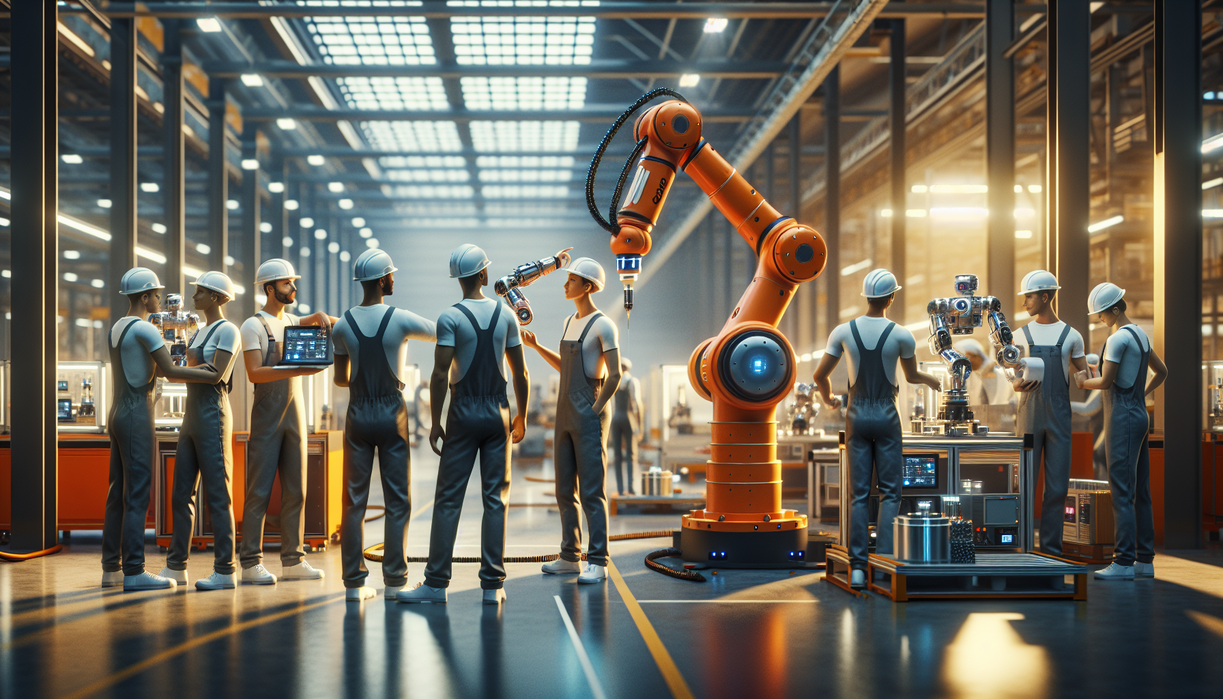
Walk into a modern plant that appears in robotics and automation news, and the first thing you notice is movement. A cobot arm tends a CNC machine, pauses as a worker steps close, then resumes once the space clears. Sensors monitor distance, torque, and speed to keep interactions safe. Instead of replacing a person, the robot takes over the monotonous loading cycle. Meanwhile, the human watches process stability, interprets data, and coaches the system.
This scene illustrates a shift from rigid industrial automation to flexible coworking setups. Traditional robots excelled at doing one thing very fast, often in isolation. Cobots excel at doing many things fairly quickly while sharing a workspace with people. That flexibility lets factories introduce automation earlier, even for low-volume or mixed-product environments highlighted in robotics and automation news.
The impact extends beyond pure output. When workers collaborate with cobots, physical strain often drops, injuries decline, and job satisfaction can improve. People move from heavy lifting or awkward postures toward oversight tasks, testing, or continuous improvement initiatives. Cobots become tools that extend human capability, not machines that push people aside. This evolving workplace dynamic explains why robotics and automation news outlets treat cobots as symbols of an industrial culture shift, not just another gadget.
How Cobots Work Beside People
Cobots earn their place in robotics and automation news because of a distinct approach to safety and control. Instead of relying solely on fences or locked cells, they use built-in safeguards. Torque sensors feel unexpected resistance, then slow or stop. Vision systems detect human presence. Software limits speed, power, and reach. These layers create an environment where proximity does not automatically equal danger, provided risk assessments remain rigorous.
Programming methods also evolve. Earlier industrial robots often required specialist programmers and complex code. Cobots lean toward intuitive interfaces that encourage frontline workers to participate. An operator might guide the arm by hand through a path, store waypoints, then use a tablet interface for adjustments. This lowers barriers to entry, enabling line leaders or process engineers to experiment. As noted across robotics and automation news, this democratization of programming accelerates innovation on the shop floor.
Crucially, collaboration is more than safe co-location. True teamwork emerges when cobots share responsibilities intelligently with people. A cobot may prepare material, screw fasteners, or apply adhesive, while a human carries out visual inspection or fine-tuning steps. Over time, data from sensors and production logs reveal patterns. Managers refine task allocation so each partner, human or robotic, focuses on strengths. This ongoing optimization is central to my view of robotics and automation news: the story is not just about machines, but about improving how work itself is designed.
From my perspective, the most underestimated aspect of cobots in robotics and automation news is cultural adoption. Purchasing a set of collaborative arms is easy; integrating them into routines, mindsets, and skills is harder. Employees need time to trust that a robot beside them will behave predictably. Clear communication about goals matters. If leadership frames cobots purely as cost cutters, resistance rises. If leadership explains them as tools for reducing drudgery and expanding capabilities, acceptance grows.
What Comes Next for Human-Robot Teams
Looking ahead, I expect robotics and automation news to highlight an even deeper fusion of digital intelligence with shop floor collaboration. Cobots will connect to cloud platforms, predictive maintenance systems, and real-time scheduling tools. They will learn from historical performance, propose optimized task splits, and adjust to sudden order changes with minimal downtime. Meanwhile, workers will need broader skills: data literacy, process thinking, cross-functional communication. The most resilient factories will treat cobots not as temporary fixes but as long-term partners in a learning ecosystem. That vision carries both excitement and responsibility, urging us to keep human dignity, skill growth, and meaningful work at the core of every new deployment.